
Pocket Mine 2
Roofdog GamesArcade
4.32.42K Reviews
- Version
- 6.10.0
- Installs
- 1.00M
- Age Rating
- Teen
Screenshots
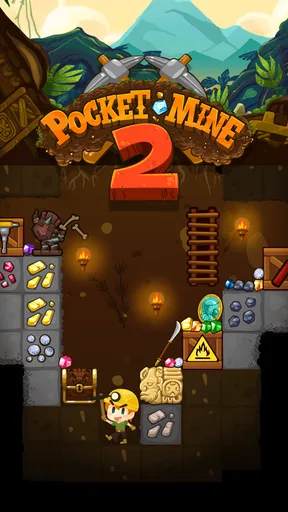
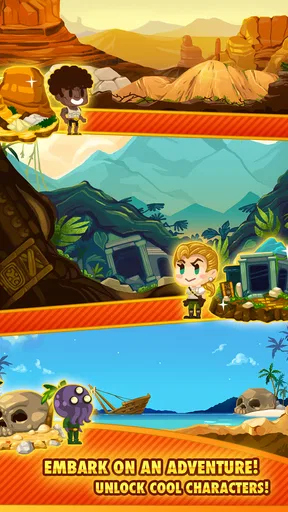
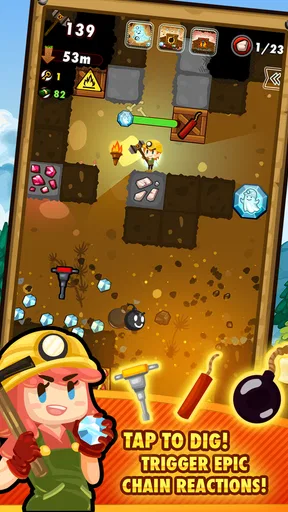

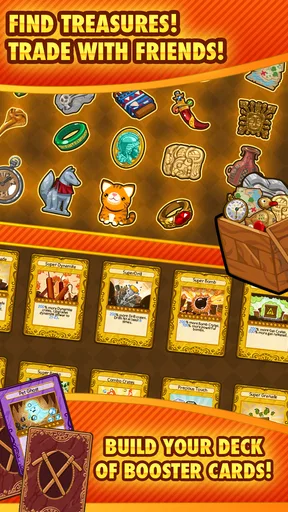
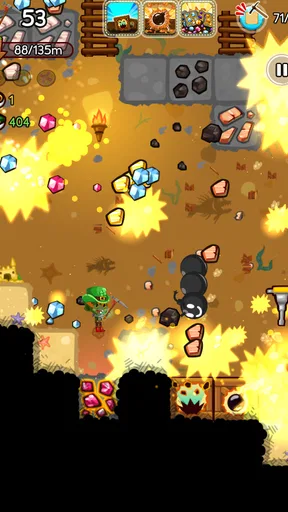
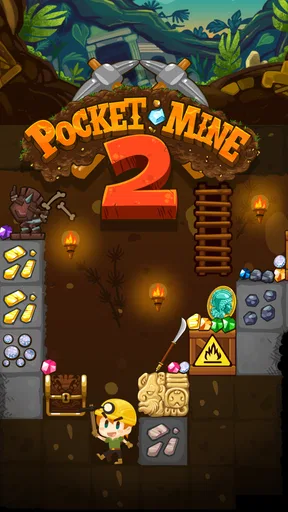
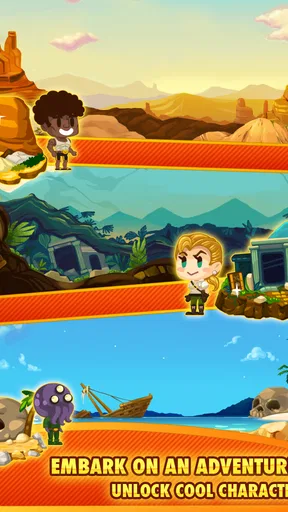
Our Review of Pocket Mine 2
 Analysis by Appyee
I went into Pocket Mine 2 expecting a quick arcade distraction, and that is exactly where it makes the best first impression. The basic idea is easy to understand: tap blocks, keep moving downward, collect useful discoveries, and work toward exploring more islands. What surprised me was how quickly that simple input becomes a small exercise in planning. Every tap feels harmless at first, but a careless route can leave me with a poor haul or an awkward position before I have reached the depth I wanted.
Developed by Roofdog Games, this free arcade game suits short sessions especially well. I can play for a few minutes while waiting somewhere, then stop without needing to commit to a long campaign. At the same time, the island structure gives the digging a sense of direction that a purely endless tapper often lacks. It is not a demanding simulation, but it does reward players who notice patterns and build a repeatable routine instead of tapping randomly.
How the digging loop feels after the first few sessions
The baseline workflow is straightforward. I start a run, look at the blocks in front of me, choose a route, and tap through the material while watching what the descent is producing. The important shift is learning not to treat every visible block as equally valuable. The fastest route downward is not always the most useful route, and the richest-looking path may cost too much time or leave me without a sensible way forward.
That balance gives the game its arcade character. I am not controlling a complicated character build or managing a large menu of statistics before every attempt. Instead, the decisions happen directly on the play area. I look, commit, react, and then decide whether to continue pushing or adjust my approach. The controls remain accessible, but the results improve noticeably once I stop playing on autopilot.
A realistic everyday use case is a short commute or a break between tasks. I can open the game, complete a compact digging attempt, and put the phone away when my attention is needed elsewhere. It also works when I want something more active than a passive puzzle but less demanding than a full action game. The downside is that the same quick-session design can make progress feel repetitive if I want a story-heavy experience or a constantly changing challenge.
The island theme helps the loop feel more purposeful. Moving through different areas gives the digging a broader sense of exploration, even though the moment-to-moment action remains focused on tapping blocks. I like that the game does not bury its central idea under unnecessary complexity. The trade-off is that players who need deep narrative context, elaborate combat, or a large social layer may find the experience too narrow.
One habit improved my results more than simply tapping faster: I began deciding what the run was meant to accomplish before starting it. Sometimes I focus on descending efficiently; at other times I take a slower route because collecting more along the way matters more. That small distinction prevents me from judging every attempt by the same standard. A run can be successful because it reached a new area, because it produced a better haul, or because it revealed which route is inefficient.
The game is free to download, which makes trying it easy, but it includes optional in-app purchases ranging from $1.49 to $29.99 per item. I would approach those purchases carefully. The basic loop is enjoyable without immediately spending money, and the best improvement for a new player is usually better decision-making rather than buying something before understanding the rhythm. Anyone who dislikes free-to-play pressure should still pay attention to the purchase prompts and decide in advance whether they want to spend at all.
Settings and small choices worth checking
There are no complicated settings that I need to master before playing, and that is part of the appeal. I would still check the device and game setup before settling into longer sessions. The current version is 6.10.0, and the game supports Android 6.0 or later. That makes it accessible on older compatible phones, although the experience will naturally depend on how smoothly a particular device handles the game and how comfortable its screen is for repeated tapping.
My practical advice is to play with a stable grip and enough screen space to see the route clearly. This sounds obvious, but a digging game punishes accidental taps more than a menu-driven app does. If I am playing one-handed while walking or carrying something, I am more likely to make rushed choices. For a focused session, I prefer using both hands or holding the phone securely so that the intended block is always obvious before I touch the screen.
The Teen content rating is also worth considering for families. It means I would not automatically hand the game to a young child without checking whether its tone and purchase options fit the household. For older players, the rating is unlikely to be a concern, but parents should still treat the purchase system as part of the setup rather than an afterthought. A quick check of device purchase controls can prevent an otherwise enjoyable casual game from becoming an unwanted expense.
Another useful setting-related habit is managing expectations around sound and attention. I do not need to play every attempt with full concentration, but I get better results when I can actually see the blocks and follow the descent. If I am in a noisy place, I rely more on visual cues and play shorter runs. If I am trying to learn a new island, I give it a quieter session rather than judging it during a distracted moment.
Players often wonder whether the game is better suited to a powerful modern phone. In my experience, the defining requirement is not high-end performance but a responsive touchscreen and a display that makes the blocks easy to distinguish. Since the minimum operating system is Android 6.0, many older devices can run it, but compatibility alone does not guarantee a pleasant experience. A small or sluggish screen can make precise route choices feel more frustrating than they should.
Repeatable patterns that make runs cleaner
The quickest improvement comes from replacing frantic tapping with a scan-and-commit rhythm. I first inspect the immediately available route, identify the direction that seems most useful, and then tap through that short sequence. After the screen changes, I pause for another look. This is faster in practice than tapping continuously because it reduces corrections and prevents me from spending actions on blocks that do not support the current goal.
I also avoid chasing every attractive discovery. Collecting is satisfying, but detouring for every opportunity can break the shape of a run. When my goal is exploration, I choose a direct route and accept that some rewards will remain behind. When my goal is gathering, I allow more side movement and judge the attempt by what it produces rather than how quickly it reaches depth. The useful skill is knowing which mode I am in before the tempting block appears.
A second advanced habit is using the edge of a route as a reference point. Instead of viewing the whole field as a collection of unrelated blocks, I try to maintain a clear sense of where my current path is going. That makes it easier to notice when I am drifting into a low-value detour. It also helps me resume decision-making after a brief interruption, which matters when the game is being played in short real-life gaps rather than in one uninterrupted sitting.
Experienced players should keep a simple mental record of what worked on each island. I do not mean writing down a detailed map; a few observations are enough. I remember whether I tend to lose time by exploring too widely, whether a certain route repeatedly leaves me poorly positioned, and whether I am prioritizing collection when I actually want progress. This turns each attempt into feedback instead of treating every run as an isolated gamble.
The tap-based design makes the game easier to pick up than many traditional arcade alternatives. Compared with an endless runner, it gives me more control over the route and less pressure to react to a constantly moving character. Compared with a conventional match-style puzzle, it feels more continuous because the objective is tied to moving through an environment rather than clearing a fixed board. Those differences make it a good middle ground for players who want quick action with a little planning.
It is not automatically better than those alternatives. An endless runner is a stronger choice if I want reflex testing and immediate restart-based competition. A match puzzle may be better when I want carefully structured levels and more deliberate board solving. Pocket Mine 2 works best when I want the satisfaction of uncovering a route while keeping the controls simple. Its strength is the combination of exploration and tapping, not depth in every arcade direction.
Where the simple design starts to show its limits
The same clarity that makes the game approachable can eventually become a limitation. The core action remains centered on tapping blocks and making route choices, so players who need constant mechanical variety may feel that the loop settles into a familiar pattern. New islands provide motivation, but they do not transform the basic interaction into a completely different genre.
There is also a real tension between relaxed play and efficient progress. If I play casually, I enjoy the discoveries and do not mind taking a longer route. If I start optimizing, I become more aware of wasted taps, poor detours, and the temptation to spend money to smooth the experience. That is not a flaw unique to this game, but it is important to recognize: the more seriously I treat progress, the less purely relaxing the arcade loop feels.
I would skip it if I am looking for a substantial narrative adventure, a competitive multiplayer game, or a title built around complex character customization. I would also hesitate if repeated tapping is uncomfortable for me or if I prefer games where every level has a clearly defined puzzle solution. The game asks me to enjoy incremental improvement and route judgment. Without that interest, the island theme will not compensate for the relatively focused gameplay.
Another limit is that short-session convenience can encourage unfocused repetition. I sometimes opened the game automatically, tapped through a run, and closed it without learning anything from the result. The fix is simple but necessary: choose a goal before starting. If I cannot name what I am trying to improve, the session is more likely to feel like empty repetition. This is one of those games where a small amount of intention makes the experience much more rewarding.
The audience response suggests that the format has broad appeal: the game holds a 4.3 average from around 67 thousand ratings and has passed one million installs. I read those figures as evidence that the basic concept connects with many mobile players, not as a guarantee that every player will enjoy its repetition. Its category is arcade, and it behaves like an arcade game should: quick to learn, easy to replay, and dependent on whether the central action remains satisfying for you.
Who gets the most from the island progression
I recommend it most strongly to people who like compact games with a visible sense of movement. The appeal is not only the tapping; it is the feeling that each decision contributes to going farther, finding more, or understanding a route better. Players who enjoy optimizing small routines will find more to think about than the store summary suggests, especially once they begin separating exploration runs from collection-focused runs.
It is also a good fit for someone who wants a game that can be played in fragments. I can stop after a short attempt without losing the entire evening, then return when I have another spare moment. That flexibility is more valuable than it sounds. Many mobile games claim to support quick play but still make me feel that I should remain connected for a long session. Here, the central action naturally breaks into manageable pieces.
For younger players, I would make the decision together with a parent or guardian because of the Teen rating and the presence of in-app purchases. For adults who are sensitive to monetization, I would recommend setting a personal rule before playing. Enjoy the free loop first, and only consider a purchase if it solves a problem you have genuinely encountered rather than an impulse created by a prompt.
Players wondering whether there is enough depth should think of the game as a habit-based arcade title rather than a large adventure. The depth comes from improving choices, learning how to approach islands, and deciding when efficiency matters more than collection. That can be enough for a satisfying long-term casual game, but it will not imitate the variety of a console-style campaign or a constantly updated competitive title.
Players wondering whether they need to spend money to enjoy it should start without spending. My own approach is to test the basic rhythm across several sessions, observe whether I am still making deliberate route choices, and only then decide whether optional purchases fit my preferences. If the tapping itself has already become repetitive, spending will not fix the central issue. If I enjoy the loop but want convenience, the decision becomes a personal value judgment rather than a requirement for understanding the game.
My verdict after settling into a routine
Pocket Mine 2 succeeds because it keeps its main idea visible. I tap, choose a direction, descend, and learn from the result. Roofdog Games has built a game that is easy to start but not completely mindless once I begin paying attention to route quality, session goals, and the difference between collecting and advancing. That is a worthwhile balance for a free mobile arcade experience.
Its best qualities appear when I use a repeatable workflow: scan the route, choose a purpose, tap in short committed sequences, and review what went wrong before starting again. Checking the device setup, protecting against accidental purchases, and playing with a clear grip may sound like small details, but they directly affect how enjoyable the game feels. These habits make the experience smoother without pretending that it offers more systems than it actually does.
The limits are just as clear. The central interaction can become repetitive, the free-to-play structure may not suit everyone, and the game is not a substitute for a story-rich adventure or a demanding competitive arcade title. I would choose a different game if I wanted constant novelty, deep customization, or precise level-by-level puzzle design.
For me, the final recommendation is positive but specific: try it if you like short digging runs, light route planning, and gradual island exploration. Treat each session as a small experiment rather than a race to tap everything, and the game reveals more personality than its compact premise suggests. If that rhythm sounds appealing, this is an easy free download to keep for spare moments; if repeated tapping and incremental progress already sound tiring, the simple design will probably feel limiting rather than relaxing.
Verdict
Strengths of Pocket Mine 2
- Simple controls make mining easy to learn.
- Many collectible artifacts encourage continued exploration.
- Equipment upgrades provide satisfying long-term progression.
- Short sessions work well for quick mobile gaming.
- Bright cartoon visuals give the game a friendly style.
Limitations of Pocket Mine 2
- Energy limits can interrupt longer play sessions.
- Progress may feel repetitive after extended mining.
- Some upgrades and boosts can encourage in-app spending.
- Randomized rewards may make specific items hard to obtain.
- The interface can feel crowded during busy excavation runs.
Similar Picks in This Category
View All
Subway Surfers
SYBO Games4.6

Stickman Party 234 MiniGames
PlayMax Game Studio4.6

Subway Princess Runner
Ivy4.4

Temple Run
Imangi Studios4.2

Zombie Tsunami
Mobigame SAS4.6

Stack Ball - Crash Platforms
CASUAL AZUR GAMES4.5
Frequently Asked Questions
What is Pocket Mine 2 and how does the gameplay work?
Pocket Mine 2 is a casual mining adventure game in which you dig through underground areas, break blocks, collect valuable materials, and discover hidden treasures. As you progress, you can improve your equipment, unlock new cards and abilities, and explore increasingly challenging locations. The gameplay is easy to understand, but choosing the right upgrades and managing your digging path adds a rewarding layer of strategy.
Is Pocket Mine 2 free to download and play?
Pocket Mine 2 can generally be downloaded for free on supported mobile devices, allowing players to begin mining without an upfront purchase. However, the game may include optional in-app purchases for items such as resources, boosts, or other upgrades. Progress is possible without spending money, although free players may encounter waiting periods, limited resources, or slower advancement compared with users who make purchases.
Does Pocket Mine 2 require an internet connection?
An internet connection may be needed for certain features in Pocket Mine 2, including advertisements, online events, cloud-related services, updates, or in-app purchases. Basic gameplay may work in some situations without a constant connection, but offline availability can depend on the device and game version. For the most reliable experience, it is best to launch the game online and check which features remain accessible offline.
Are there advertisements or in-app purchases in Pocket Mine 2?
Yes, Pocket Mine 2 may contain advertising and optional in-app purchases. Advertisements can sometimes provide useful rewards, such as additional resources or bonuses, but they may also appear between activities or after completing certain actions. Purchases are designed to speed up progression or provide extra benefits rather than being strictly required, though players who prefer a completely uninterrupted experience should review the store and device settings before playing.
Is Pocket Mine 2 suitable for children and casual players?
Pocket Mine 2 is accessible to casual players because its controls are straightforward and the core objective is introduced quickly. Its colorful presentation and short mining sessions make it easy to play in brief periods. Parents should still review the age rating, advertising, and purchase options before allowing younger children to play, since the game may encourage optional spending and can include online-connected features depending on the platform.
Play our best games!


